Sustainable Accessibility Across 12 Digital Channels: From Regulatory Compliance to App Store Accessibility Labels
Discover how QNB transformed 12 digital channels through disabled-user testing, team training, and accessible development practices.
12
Digital channels
WCAG 2.2
Compliance standard
At a Glance
| Client | QNB – one of Türkiye's largest banks |
| Industry | Banking / Finance |
| Scope | 12 digital channels: retail and corporate banking apps, GSPara, Fener Para, Dijital Köprü, and websites |
| Compliance objective | WCAG 2.2 and the Level A Checklist for the Accessibility of Websites and Mobile Applications under Presidential Circular No. 2025/10, alongside banking regulations |
| Headline result | The first bank in Türkiye to publish App Store Accessibility Nutrition Labels |
| Binclusive's role | Testing with disabled users, reporting, team training, AI skill integration, and a sustainable accessibility process |
About the Client
QNB serves millions of retail and corporate customers as one of Türkiye's largest and most established banks. At this scale, digital channels are no longer an alternative to banking; they are banking itself. Most services—from money transfers and loan applications to bill payments and investments—now take place through mobile apps and the web.
Making these channels independently usable by everyone, regardless of disability, is therefore both a corporate responsibility and an important part of regulatory compliance.
The Challenge
The regulatory timetable became clear
Presidential Circular No. 2025/10 on the Accessibility of Websites and Mobile Applications, published in Türkiye's Official Gazette on 21 June 2025, requires organizations including banks to make their websites and mobile applications conform to the Level A Checklist for the Accessibility of Websites and Mobile Applications and WCAG 2.2 within one year. The Circular also established a monitoring structure within the Ministry of Family and Social Services and promotes sustainable self-assessment and remediation.
Together with Türkiye's Regulation on the Accessibility of Banking Services, which requires internet and mobile banking applications to comply with accessibility standards, this made accessibility a time-bound and measurable compliance priority for QNB.
Not one application, but 12 channels
QNB's digital accessibility scope extended far beyond a single app:
- Retail Banking and Corporate Banking mobile applications
- GSPara and Fener Para digital wallet applications
- Dijital Köprü
- Websites operated by the bank and its brands
The 12 channels were maintained by different product teams using different technology stacks and release cadences. A problem resolved in one channel could not automatically be fixed everywhere else.
Banking requirements narrowed the solution space
Authentication steps, transaction approval flows, timeout rules, and security requirements meant accessibility solutions had to be designed specifically for banking. Every decision that improved the experience for a screen reader user also had to satisfy security and regulatory requirements.
Sustainability was the real goal
Making 12 channels accessible once would not be enough. New screens were added every sprint, flows changed, and components evolved. Accessibility needed to become part of the product development culture so improvements would endure and compliance could be maintained.
QNB and Binclusive began working together toward that goal.
The Approach
Binclusive's approach rested on three principles: testing with real users, enabling teams to become self-sufficient, and embedding accessibility into delivery processes.
1. Testing real journeys with disabled users
The user journeys supplied by QNB's teams were tested by people with different disabilities. VoiceOver and TalkBack users, as well as people with low vision and motor or cognitive disabilities, completed critical journeys such as money transfers, bill payments, and card transactions from end to end.
Every identified issue was reported with:
- The user group, screen, and step affected
- The relevant WCAG 2.2 and Ministry checklist criterion
- Practical remediation guidance for product, design, and engineering teams
Teams learned not only what was failing, but also how to fix it.
2. Team training based on real product issues
Instead of generic accessibility theory, the training used issues found in QNB's own channels:
- Product teams: Writing accessibility requirements into user stories and acceptance criteria
- Design teams: Contrast, focus order, touch targets, component labelling, and accessibility in the design system
- Engineering teams: iOS, Android, and web accessibility APIs; semantics in custom components; form and error management
3. Integrating Binclusive AI skills into development
Engineering teams made Binclusive AI skills part of their development workflow. Developers could apply accessibility checks while writing and reviewing code, turning accessibility from a defect discovered late into a quality requirement addressed during implementation.
4. Adding an accessibility stage to delivery checklists
Accessibility checks became a distinct stage in QNB's product delivery checklists to preserve improvements as products evolved. A feature is no longer considered complete until it meets the relevant accessibility criteria.
Results
The first bank in Türkiye to publish App Store accessibility labels
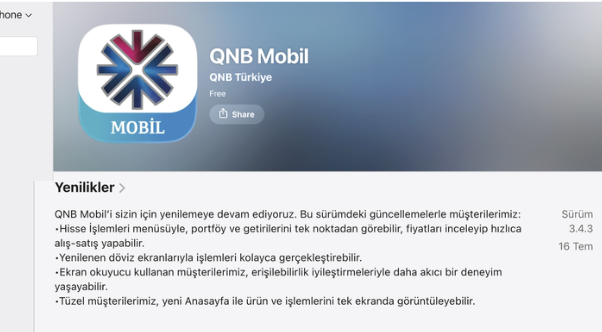
QNB became the first bank in Türkiye to publish Accessibility Nutrition Labels on its App Store product pages. These labels show users before download which accessibility features the app supports. QNB also announced improvements for customers using screen readers in its App Store release notes.
Accessibility improvements in Google Play release notes
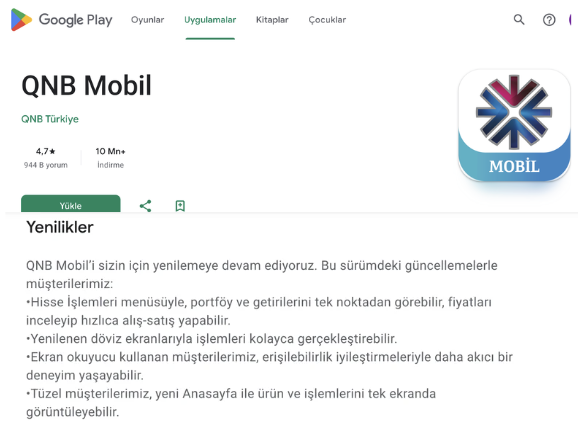
QNB also communicated its accessibility work through its Google Play release notes. The notes explain that font sizes and color contrast were aligned with accessibility standards, screen reader support was improved, and accessibility would continue to be enhanced sustainably.
Regulatory compliance gained a sustainable foundation
Compliance with Presidential Circular No. 2025/10 and banking regulations became an ongoing practice supported by checklists, team capability, and an AI-assisted development process—not a one-off audit exercise.
Accessibility became part of team culture
Product, design, and engineering teams began treating accessibility as a natural part of their work rather than an external audit requirement. New features are now conceived with accessibility from the design stage onward.
A tangible improvement in user experience
“Using the app with VoiceOver used to require a great deal of patience, and transaction screens would constantly freeze. With the latest update, the app has become incredibly stable and accessible. I can now complete my transactions smoothly without getting stuck.”
— İdris E., Teacher
Are Your Digital Channels Accessible to Everyone?
The compliance timetable under Presidential Circular No. 2025/10 is moving forward for banks and other covered organizations. Digital accessibility is both a condition of meeting accessibility standards and a foundation for a more inclusive, independent user experience.
As in our work with QNB, Binclusive tests digital channels with real users, trains teams, and makes accessibility a lasting part of the development process.


